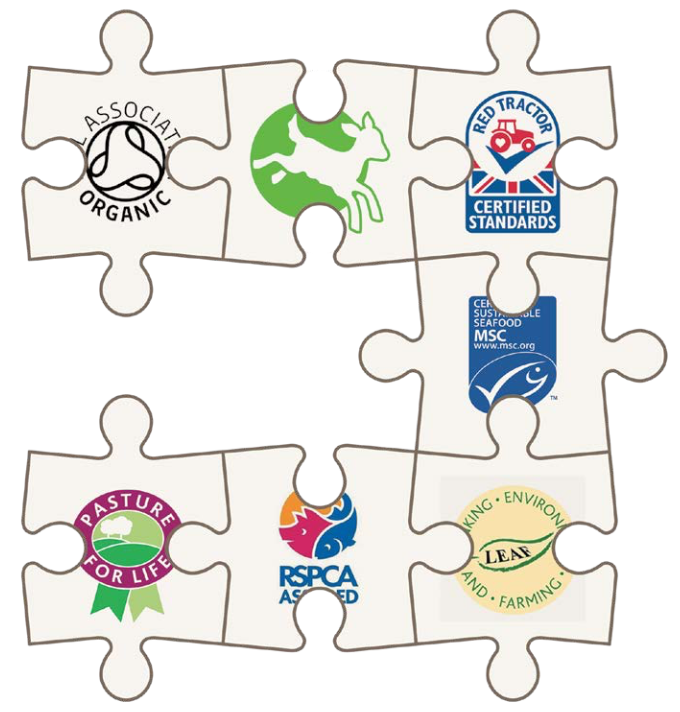
New research suggests that although people take confidence from food certification labels they often don’t know what they mean. Nick Hughes reports.
Those looking to make more sustainable food choices often turn to third-party certification labels for help. But are these labels well understood and do they actually affect people’s purchasing habits? New YouGov research set out to find the answer and the results are illuminating.
Of the six labels people were asked about, the most widely recognised was the British Lion mark. Some 82% of the 2,000 people surveyed said they recognised the label, which is commonly used on UK eggs. Next came the Red Tractor symbol which enjoyed 74% recognition followed by the Fairtrade logo (70%), the Marine Stewardship Council (MSC) ‘blue tick’ (62%) and the RSPCA Assured label (61%). The least well-recognised label of the six was the Soil Association’s ‘Organic’ label (51%).
Recognition is one thing but do people believe they know what these labels mean? Many don’t. For five out of the six labels less than half who recognised them said they knew “exactly” what they meant. The only exception was Fairtrade which enjoyed 70% recognition of which 37% of people were confident they knew what it stood for. By contrast, only 22% of people were sure of what the MSC and RSPCA Assured labels meant and only 18% expressed certainty about the Soil Association label.
People might believe they know what these labels mean but is that the case in reality? There are certainly plenty of misconceptions, albeit the survey data doesn’t break down whether it is those same people who express certainty in what a label means that are in fact misinformed. Take the British Lion mark for example: just over four out of ten (42%) of those who recognised it correctly identified that it denotes that the egg has come from a British farm. However plenty also ascribed additional credentials to the mark: 28%, for example, thought it meant higher animal welfare standards despite eggs from caged hens being able to display the mark.
Only a third (31%) of those familiar with the Red Tractor label correctly thought it denoted produce sourced from within the UK, while a further third thought it meant higher standards of welfare for animals despite Red Tractor standards often being only slightly above the legal baseline.
Scheme owners may be happy to let people assume a label stands for higher standards than it does, but the public interest is arguably best served where there is clarity.
So do these labels impact purchasing decisions? Rather than a clear cut ‘yes’ or ‘no’ answer to this question, the truth lies somewhere in the middle. YouGov’s research suggests that although Britons tend to prefer products that display certification labels the majority do not actively seek products that carry them. Around a quarter actively look for the MSC, Fairtrade, British Lion and Red Tractor marks, dropping to under 20% for RSPCA Assured and Soil Association Organic.
What can we conclude from the results then? Firstly, that people take confidence from labels being there but don’t necessarily use them to make purchasing decisions. And secondly, that people are often unclear what these labels mean even when they recognise them. This doesn’t mean that food certification labels have little value, but it does suggest that those organisations developing unified eco-labels have the opportunity to remove some of the confusion that inevitably results when the public have to navigate a wide range of different schemes that certify a wide range of different things.